

The Gulf of Guinea (GoG) is a cornerstone of Africa’s maritime landscape. Rich in hydrocarbons, fisheries, and minerals, and home to nearly 20 commercial seaports, the region handles about 25% of Africa’s maritime traffic. Nigeria and Angola—the continent’s largest oil producers—sit along its coast, underscoring its global economic importance. Yet, persistent maritime threats such as piracy, armed robbery, and illegal fishing have made the GoG a focal point for security concerns. In 2020 alone, the region accounted for 130 out of 135 maritime kidnappings worldwide.
Purpose of the Training
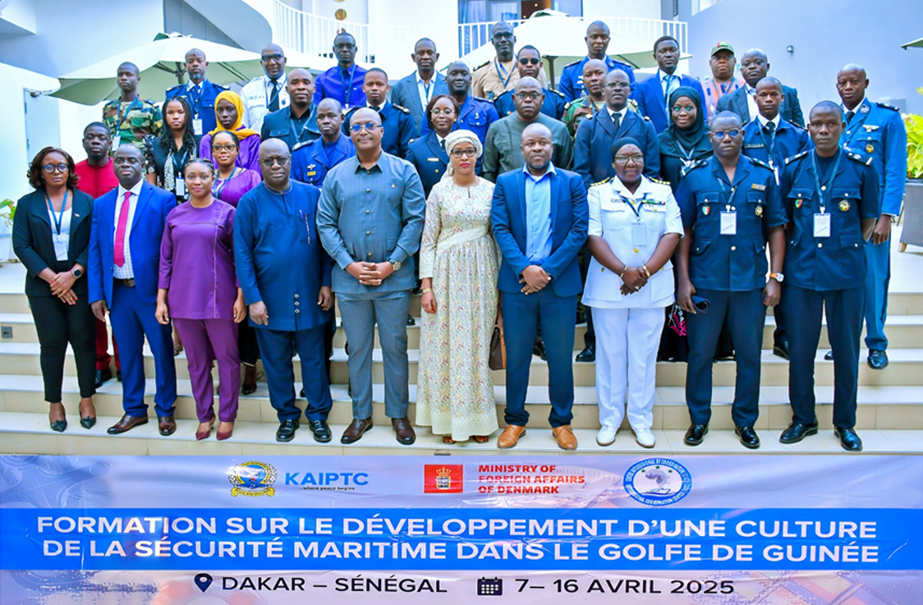
To address these challenges, the Kofi Annan International Peacekeeping Training Centre (KAIPTC), with support from the Government of Denmark, organized the multinational training course “Developing Maritime Security Culture in the Gulf of Guinea”. Held in Dakar, Senegal, from 7–16 April 2024, the course convened 34 maritime security practitioners from Senegal, Guinea-Bissau, The Gambia, Nigeria, and Liberia, including eight female participants. Its objectives were to deepen understanding of maritime security, foster collaboration, and promote gender-inclusive approaches to managing regional threats.
Opening Highlights
The course began with an opening ceremony featuring remarks from Mr. Alioune Cissokho of HASSMAR, Air Commodore David A. Akrong, Deputy Commandant of KAIPTC, and Mme Oumy Ka of HASSMAR. Mr. Cissokho highlighted Senegal’s maritime heritage and strategic role in the GoG, while the Deputy Commandant emphasized the importance of regional cooperation, adaptive responses to evolving threats, and inclusion of underrepresented groups such as women.
Conceptual Foundations
The first sessions laid the groundwork for understanding maritime security in the GoG. Prof. Kwesi Aning explored the blue economy as a policy imperative, emphasizing sustainability, governance, industrialization, and growth. Participants discussed how adaptive strategies and regional collaboration could transform maritime opportunities. Mrs. Serwaa Allotey-Pappoe mapped maritime stakeholders, highlighting the roles of state actors, intergovernmental organizations, and non-state actors, and underscored the importance of coordination, information sharing, and inclusivity.
Legal & Policy Frameworks
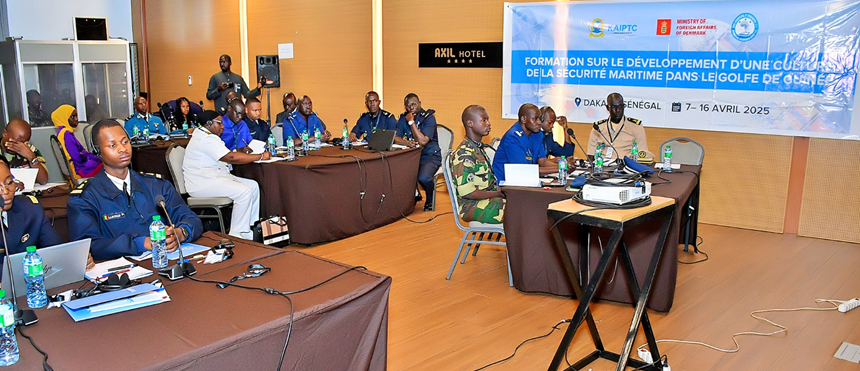
Understanding the regulatory environment is critical for effective maritime security. Mr. Alioune Cissokho provided an in-depth review of international conventions (UNCLOS, SUA, IMO, UNTOC), regional strategies (AIMS 2050, ECOWAS, ECCAS), and national legal frameworks, including Senegal’s laws on maritime policing, merchant marine, fisheries, and environmental protection. He emphasized harmonization, interagency cooperation, and the role of national authorities like HASSMAR in coordinating security, safety, and environmental protection.
Functional Areas of Maritime Security
The course examined practical aspects of maritime security:
- Maritime Governance: Dr. John Pokoo highlighted institutional responsibilities, policy development, and accountability.
- Intelligence and Information Sharing: Capt. Bamale explained the intelligence cycle and the importance of interagency information exchange.
- Marine Environment Protection: Captain (Rtd) Alioune Diop focused on the legal, ecological, and institutional aspects of environmental governance, emphasizing cooperation and enforcement.
- State Action at Sea (AEM): Presenters explored Côte d’Ivoire’s and Senegal’s experiences in interagency coordination, crisis response, and operational structures.
Gender Inclusion
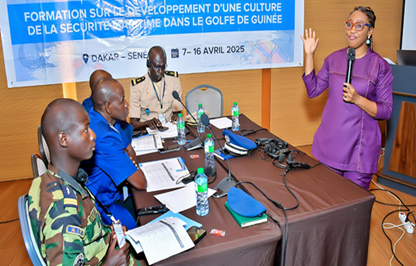
A key component of the course was integrating gender into maritime security. Ms. Serwaa Allotey-Pappoe and Dr. Emma Birikorang explored structural barriers, gender mainstreaming, and the Code of Practice for Women in Maritime Security. Participants reflected on harmful gender norms and strategies to promote inclusivity, linking gender equality directly to operational effectiveness and sustainable maritime governance.
Inter-Agency Collaboration
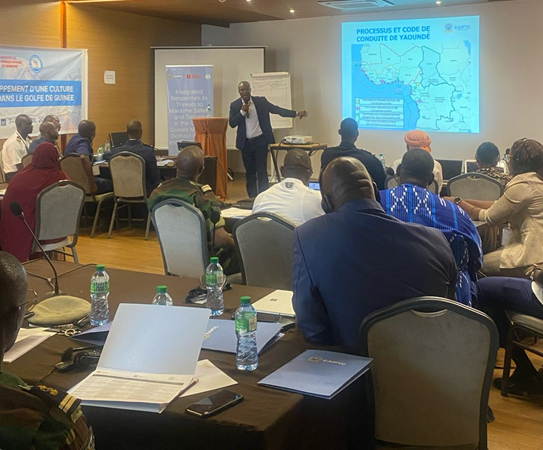
Capt. Diop facilitated discussions on managing relationships across complex institutional landscapes. Effective collaboration—based on common understanding, unity of objectives, continuous communication, and mutual respect—was emphasized as essential for maritime security. Participants assessed the Yaoundé Architecture, identifying challenges such as limited resources, weak coordination, funding gaps, and human resource constraints, and recommended actionable solutions to strengthen regional cooperation.
Course Outcomes
Evaluation results were overwhelmingly positive. Participants’ self-assessed knowledge rose from 56% to 84%, while overall satisfaction averaged 90%. High scores were given for course objectives, content relevance, and facilitator capacity. Participants expressed strong intentions to apply their learning in professional roles and recommended expanding practical exercises, improving time management, and enhancing interpretation services.
Conclusion
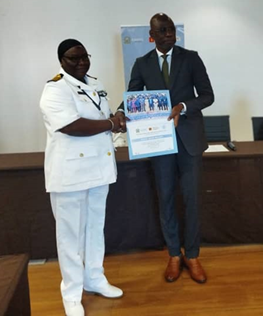
The “Developing Maritime Security Culture in the Gulf of Guinea” course successfully brought together security practitioners, policymakers, and civil society representatives to build a collaborative and gender-inclusive approach to maritime security. By combining legal, operational, environmental, and strategic perspectives, the training laid the foundation for a shared maritime security culture capable of addressing evolving threats in the Gulf of Guinea. Participants left with renewed commitment to regional collaboration, capacity-building, and knowledge sharing for safer and more secure maritime spaces.